What if your biggest competitor in 2026 isn't the shop down the road, but the mountain of spreadsheets on your own desk?
It's a common trap. You're drowning in manual entries while trying to navigate a 27% corporate tax rate and looming SARS deadlines. You know that every hour spent wrestling with fragmented data is an hour lost to growth. It's exhausting. It's expensive. And frankly, it's unnecessary.
High operational costs shouldn't be the price of doing business in South Africa. You deserve a business that runs itself. This guide shows you exactly how to streamline business operations in South Africa by eliminating administrative friction and using a unified operating system. We'll show you how to move from chaos to a single, clear view of your enterprise health.
You'll learn to automate your accounting and payroll, ensuring compliance without the midnight anxiety. It's time to trade your spreadsheets for strategic leadership and professional mastery.
Key Takeaways
- Identify the hidden costs of manual data entry and see how siloed tools act as a brake on your growth.
- Learn how to streamline business operations by moving from fragmented software to a single, unified Business Operating System.
- Discover how automating your accounting and payroll removes the anxiety of SARS compliance and frees up your schedule.
- Follow a practical 5-step roadmap to audit your current administrative stack and eliminate operational bottlenecks.
- Explore how modern enterprises use integrated software to gain a clear, up-to-date view of their total business health.
Identifying Operational Friction in South African Enterprises
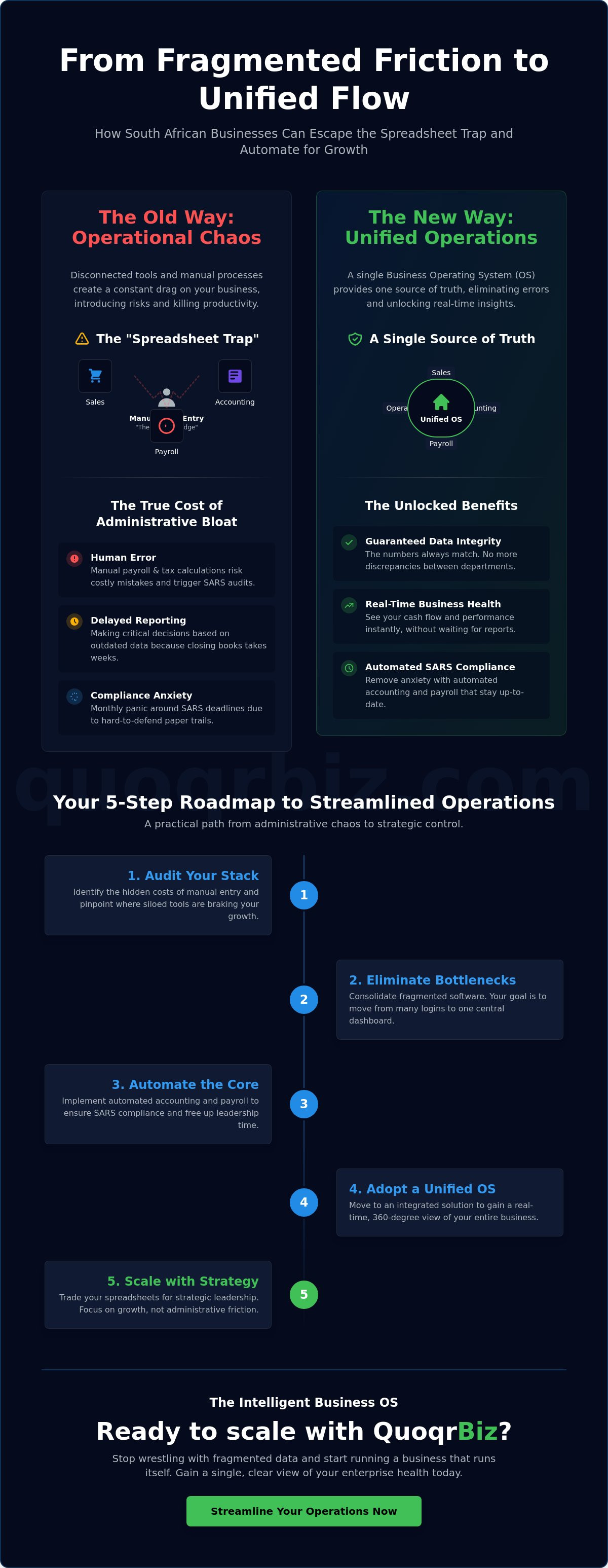
Operational friction isn't just a buzzword. It's the invisible cost of every manual data entry and every disconnected tool in your office. Think of it as grit in the gears of your growth. When you try to streamline business operations, you quickly realise that traditional 'siloed' software is the primary culprit. One system handles sales. Another handles payroll. A third handles invoicing. They don't talk to each other.
This silence forces your team to become human bridges, manually moving data across gaps. It's slow. It's draining. And it's entirely avoidable.
The 'Spreadsheet Trap' is where this friction becomes dangerous. Critical data lives in unlinked Excel files that only one person understands. If that person is away, the business stalls. This isn't just an admin headache — it kills employee morale and drags down customer service.
The True Cost of Administrative Bloat
Administrative bloat is a silent profit killer. Every hour spent on manual reconciliation is an hour not spent on strategy. Consider the risks it introduces:
- Human error: Manual payroll and tax calculations are prone to mistakes that trigger SARS audits.
- Delayed reporting: If it takes two weeks to close your books, you're making decisions based on the past.
- Compliance anxiety: Paper trails are harder to defend during a regulatory check.
Recognising the Signs Your Business is Outgrowing its Tools
Look for the discrepancies. If your sales report doesn't match your bank statement, you have a problem. Your business has outgrown its tools if you see these red flags:
- Frequent data mismatches between your sales and accounting departments.
- SARS compliance deadlines becoming a source of monthly panic.
- An inability to answer simple questions about business health without 'checking the spreadsheet.'
The 2026 Blueprint for a Unified Business Operating System
Forget the patchwork of apps. The future of enterprise management isn't about linking tools together — it's about a Business Operating System (OS). One digital environment for every core function. When you move to a unified system, you get a single source of truth. One login. One view. Complete control.
Cloud-based infrastructure is the backbone of this blueprint. In South Africa, scalability requires flexibility. You need a system that grows across provinces without requiring on-site servers or complex setups.
Moving Beyond Fragmented Software Stacks
Managing five different logins is a liability. It's a security risk and a productivity killer. When your accounting, payroll, and operations live in one place, data integrity is guaranteed. The numbers always match. This level of clarity allows you to streamline business operations with total confidence.
Mobile-First Accessibility
Business doesn't just happen at a desk. You need to manage approvals while on the move — whether it's reviewing an invoice or checking leave requests. A cloud-based system with a responsive, mobile-friendly interface ensures your team can stay productive from anywhere in the country.
Automating the Core: Financial Workflows and SARS Compliance
Finance is the engine room of your enterprise. To effectively streamline operations, you have to automate the 'big two': accounting and payroll. These are high-stakes compliance areas. One wrong decimal point in a tax filing can lead to months of administrative pain. Automation replaces that anxiety with certainty.
Frictionless Payroll Management
Payroll is more than just paying salaries. It's a compliance dance involving UIF, SDL, and PAYE. Doing this manually is a recipe for disaster. An intelligent system automates these calculations accurately based on the latest 2026/2027 SARS tax brackets. No more spreadsheets. No more guesswork.
You can generate professional digital payslips with a single click, and all payroll data is stored and structured to make IRP5 preparation straightforward at year-end. Leave management and employee records live in the same environment, ensuring your payroll data is always current.
Seamless Accounting and VAT Readiness
All your invoices, payroll runs and expenses are captured in one place, giving you an up-to-date view of your cash flow without hunting across spreadsheets. Your income and outgoings are always visible in a single dashboard.
You can generate SARS-compliant VAT reports and reconciliations without hiring a consultant for every query. Because your invoicing, expenses and payroll all live in one system, your financial picture is always current — no manual consolidation across separate tools, no reconciliation headaches. That's the power of a true Business OS.
A 5-Step Roadmap to Streamlining Your Operations
Efficiency isn't an accident. It's a choice. Follow this five-step blueprint to reclaim your time and scale your enterprise.
**Step 1: Audit your stack. **Identify every tool you use. If it doesn't connect to your other systems, it's a bottleneck.
**Step 2: Choose a unified Business OS. **Stop buying single-purpose apps. Invest in one digital environment that handles accounting, payroll, and core operations.
**Step 3: Centralise your data. **Move everything into one source of truth. When your sales data lives with your financial data, silos disappear.
**Step 4: Automate the repetitive. **Start with payroll and invoicing. These are the biggest time-wasters. Automate them first to see immediate relief.
**Step 5: Review and refine. **Use your dashboard data to spot new friction points. Continuous improvement is the mark of a professional operation.
Auditing Your Current Administrative Stack
Most businesses pay for software they don't use. Start by mapping the flow of data from a sale to your bank account. How many times is that data manually re-entered? If the answer is more than once, you've found a leak. Watch out for 'shadow IT' — apps employees use on the side because the main system is too clunky.
Phased Migration and Team Adoption
Don't try to change everything in a single afternoon. Start with a phased migration. Move your payroll first — get a win. Then move your invoicing and accounting. This builds confidence. Show your team how much time they'll save. When the team sees the relief, they'll never want to go back to the old way.
Scaling with QuoqrBiz: The Intelligent Business OS
Scaling a business shouldn't mean scaling your stress levels. QuoqrBiz is designed to streamline business operations by providing a single, intelligent environment for your entire enterprise. It's more than just software — it's a partner that handles the administrative heavy lifting so you can focus on strategic leadership.
Built for the Modern African Enterprise
Local context matters. You operate in a landscape with specific SARS requirements and South African labour laws. QuoqrBiz is built for this reality — handling the nuances of the local market from PAYE and UIF calculations to VAT submissions. This isn't a generic global tool with a local patch. It's a system designed from the ground up for South African SMEs.
The QuoqrBiz Advantage: Radical Simplicity
Complexity is the enemy of efficiency. QuoqrBiz breaks the cycle with radical simplicity. No more hunting through menus. No more translating technical jargon. Because everything is all-in-one, you don't need complex integrations or third-party connectors. Everything works together because everything is part of the same engine.
It's time to stop fighting your tools and start using them to win.
Take Command of Your Enterprise Growth
Join the modern African enterprises leading the way. Your time is your most valuable asset. Stop wasting it on spreadsheets and start investing it in your legacy.
Frequently Asked Questions
How do I know if my business operations need streamlining?
You need to streamline operations if your team spends more time on admin than on serving customers. Look for red flags like manual data re-entry between systems or reliance on unlinked spreadsheets. If SARS deadlines cause monthly panic, your current processes are failing you.
Is it expensive to switch to a cloud-based business operating system?
Switching is often more cost-effective than maintaining a fragmented stack of separate subscriptions. You eliminate the hidden costs of human error and hours lost to manual reconciliation. Modern systems offer tiered pricing that scales with your business growth.
Can automated payroll really ensure SARS compliance?
Yes. A system designed for the South African market handles UIF, SDL, and PAYE calculations automatically based on the latest 2026/2027 tax brackets. Payslips are generated digitally and all data is structured for IRP5 preparation — giving you peace of mind without the stress of manual calculations.
What is the difference between integrated tools and a unified Business OS?
Integrated tools are separate apps linked by 'bridges,' while a unified Business OS is a single engine. When your accounting and payroll share the same database, there are no sync errors or data discrepancies — only one source of truth.
How long does it take to implement a new business management system?
Implementation can happen in days rather than months with a system built for simplicity. A phased approach is best — start with payroll to get an immediate win, then migrate your invoicing and operational data. Cloud-based solutions don't require on-premise installation, which speeds up the entire process.
Will my team find it difficult to learn new software?
Not if the software uses an intuitive, modern interface. Your team will embrace a system that removes repetitive, boring parts of their daily routine. Good software feels natural — this makes the transition empowering rather than a chore.
Can I manage my South African business from my mobile phone?
Yes. QuoqrBiz is built to be fully accessible on mobile. You can review invoices, check leave requests, and monitor your dashboard directly from your smartphone — ensuring you're never the bottleneck in your own growth story.